Light in Darkness: Advent Symbolism in Art
 Annunciation Triptych (Merode Altarpiece). Image courtesy of Wikimedia Commons.
The liturgical season of Advent is one of the most anticipated of the Christian calendar as it forecasts the birth of Christ. Artists have, for generations, been drawn to depictions that celebrate the light of this holy birth and the interplay of physical and spiritual darkness in compositions that encourage artistic and religious reflection. This light-filled approach transcended the holy aspects to serve as striking, universal reminders of the power of hope in our modern world.

La Visitation avec Marie-Jacobie et Marie-Salomé – Domenico Ghirlandaio. Image courtesy of Wikimedia Commons.
In celebration of the approaching Advent season, this article explores how European artists embraced these themes both through masterful play of light and shadow alongside symbolism that alludes to the divine interjected into the realm of mere mortals. From the devotional works of Fra Angelico to the contemporary contemplations of Mark Rothko, we’ll peruse artists whose works encourage introspection and engage with the timeless tension between the shadowy world of humanity and the lightness of religious revelation.
Accessing the Symbolism of Advent
The promise of the Advent season is captured across art history; however, it is rarely conveyed via depictions of the season directly. Rather, artists cleverly devised a set of conventional narratives and symbols that could hint at the theologically significant time of Advent while also alluding to the larger hope of redemption or salvation.
Common Narratives Associated with Advent
One of the most popular subjects selected by artists to celebrate Advent was that of the Annunciation. Conventionally depicted as the moment the Angel Gabriel appears to the Virgin to relay the news of her impending immaculate conception of Christ, this significant moment gave license for bold beams of divine light to often slice through the scene as a visual metaphor. Similarly powerful were scenes of the Visitation, wherein the Virgin meets with her similarly pregnant sister, Elizabeth, who will eventually give birth to John the Baptist. In these scenes, stark rays of brilliant light were replaced by glowing auras or light-filled backgrounds that accentuated the often tender embrace between two sisters and relayed a sense of hope to the viewer of the potential salvation of the world ahead.
Common Symbols Associated with Advent
Glimmering rays of light were not the only means to convey the season’s specialness. Often, light was complemented with the use of deep shadows to create a contrast in mood. Angelic figures, also often set in an aura of seemingly supernatural light conveyed by opulent gold ground, and candles burning brightly could also serve as stand-ins or reminders of the upcoming divine revelation of Christ.
The Art of Advent
The beauty of these light-filled Advent scenes is realised with a few spectacular examples. Join us as we peek at some of the most light-filled art from the Renaissance onward to inspire your Advent season.
Fra Angelico (c. 1395-1455)
-

- Manner of Fra Angelico, Angels with Instruments: A Pair of Oils with Gold-Ground on Panel. Sold for $3,200 USD via Weschler’s (September 2015).
-

- Manner of Fra Angelico, Angels with Instruments: A Pair of Oils with Gold-Ground on Panel. Sold for $3,200 USD via Weschler’s (September 2015).
A Dominican friar turned artist after joining his religious order, Guido di Pietro – better known as Fra Angelico – offered some of the most scintillating devotional frescoes of his generation. His palette overall was muted, a decision informed by both his medium (fresco) and his location, as many of his works adorned the plain, contemplative interiors of his fellow friar’s cells in the Florentine Monastery of San Marco. Despite this subdued sense, Far Angelico’s compositions exuded a tasteful sense of divine inspiration.
The Annunciation, for example, which graced one of the monastery’s main corridors, captures the moment of the Angel Gabriel’s arrival with soft, still composure. Pastel hues and a warm wash of light illuminate the arcaded terrace on which the Virgin acknowledges and accepts her destiny. With these gentle colours and gestures, Fra Angelico offered to his 15th-century brethren a contemplative and anticipatory scene that became the model for his other works and for many followers.

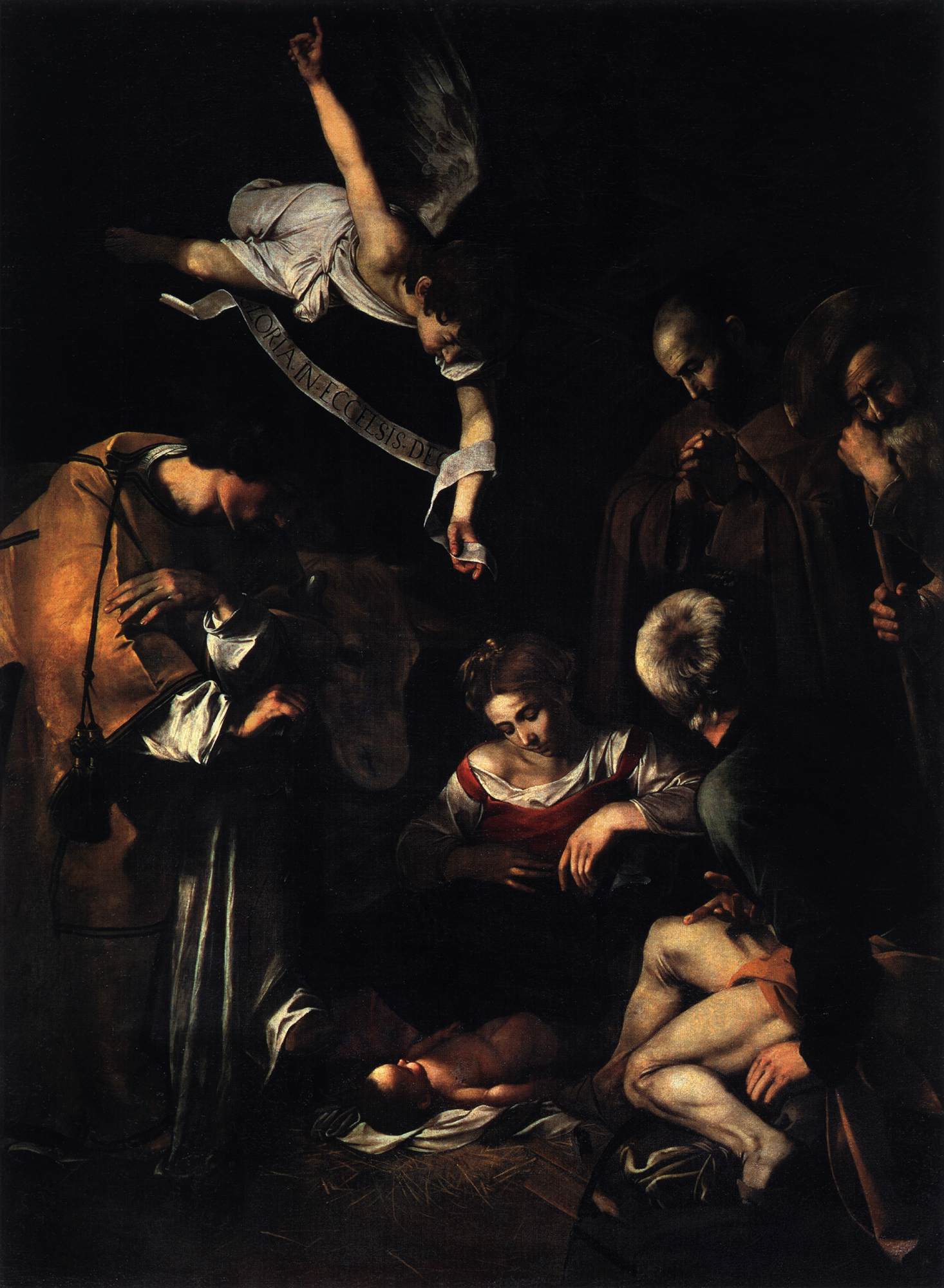
Michelangelo Merisi da Caravaggio, Nativity with St. Francis and St. Lawrence. Image courtesy of Wikimedia Commons.
Michelangelo Merisi da Caravaggio (1571-1610)
Fra Angelico’s tame treatment of the Annunciation stands in direct contrast to Caravaggio’s treatment of the subject 150 years later, a testament to the rapid pace at which artistic tastes transformed from the Renaissance to Baroque eras. Despite this difference in technique, Caravaggio’s Annunciation (c. 1608) nevertheless epitomises the visual potential of heightened contrasts between light and shadow to augment the divine symbolism of the scene.
Caravaggio is known for his use of tenebrism, or the abrupt transitions from intense highlight to deep shadow, that dramatised many of his most iconic paintings like Nativity with St. Francis and St. Lawrence. The same can be said of his Annunciation, where a powerful raking light rushes into the composition at upper left and amplifies the body of the Angel Gabriel as he rushes into the scene.
Especially articulated is Gabriel’s hand, which extends outward to touch the Virgin who has already kneeled in supplication at the painting’s lower right. Caravaggio’s clever use of light once again draws our eye to the Virgin’s gently crossed hands and partially closed eyes to underscore her compliance, while her smaller presence in relation to the swell of fabric around the angel’s body above suggests her humility as a mere mortal accepting divine responsibility. Her gesture was made even more powerful with the plunge of the remainder of the painting into dark shadows. Here, Caravaggio’s use of light and shadow contributes to an almost theatrical composition that engages the viewer to partake in religious reflection.

Rembrandt Harmensz. van Rijn – The Adoration of the Kings. Sold for £10,965,300 GBP via Sotheby’s (December 2023).
Rembrandt van Rijn (1606-1669)
Of Caravaggio’s same Baroque era yet even more nuanced in his exploration of light, Dutch artist Rembrandt aimed to employ light in his prints and paintings to add psychological depth and compositional intimacy. His Visitation (1640) sets the important episode under the light of the moon, subtly suggested by the soft glow that emanates from the painting’s upper right. Even brighter than that moonglow, though, is the warm light that showcases the aged Elizabeth and youthful Virgin mid-embrace in the centre of the composition.
The artful use of this highlight, which slowly fades as the eye heads outward to the other figures and elements Rembrandt incorporated, emphasises this tender connection between sisters. In doing so, Rembrandt combined his interest in creating complex compositions that could respond to contemporary tastes while also reinforcing the divine light within. This transformative quality was even more powerful in his other religious works like Adoration of the Kings and Sacrifice of Isaac.
Dante Gabriel Rossetti (1828-1882)

Dante Gabriel Rossetti – The Seed of David. Image courtesy of Wikimedia Commons.
As a founding member of the Pre-Raphaelite Brotherhood, a network of 19th-century artists who sought a renewed purity to their painting derived from medieval traditions, Dante Gabriel Rossetti was equally masterful in his manipulation of light and shadow in his religiously themed works. Such can be seen in his drawing of The Annunciation (1855), with luminous colour that enhances the moment’s mystical quality. Here an ethereal angel looms over the Virgin as she descends to the edge of a stream, the reflective surface of which seems to cast an almost electric aura around the Virgin’s body.
The same can be said of The Adoration (also known as The Seed of David) (1856), a watercolour painting depicting the celebration of Christ’s birth. Admittedly a moment that occurs beyond the period of Advent, Rossetti’s composition nevertheless upholds the celebration of light and promise that can be sensed in these other paintings. Glowing gold halos and wings frame each of the many angels who peer in on the intimate moment and amplify the presence of the singular standing angel who joins in the scene. Light also illuminates the tender embrace between the Virgin and Christ child at the composition’s centre as a reminder of the significance of this Biblical moment.
Mark Rothko (1903-1970)
While artists of 20th-century modernism were less concerned about painting religious subjects, some, like Mark Rothko, were invested in the role of colour and light. As a pioneer of Colour Field painting, Rothko set out in his work to achieve a renewed sense of compositional purity. The result of this pursuit was a body of work that transformed various hues and tones into a space of contemplation, longing, and hope.

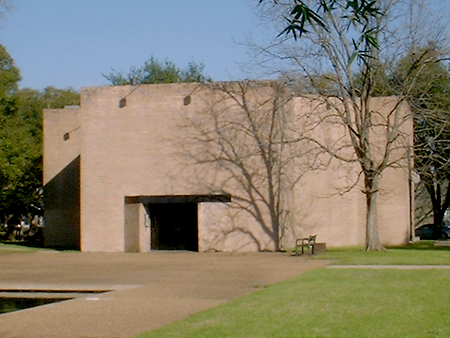
Mark Rothko Chapel, courtesy of dappledwithshadow via Flickr.
These themes are perhaps best illustrated in the Rothko Chapel (1964), a non-denominational space of worship taking the form of a Greek Cross plan and featuring fourteen installed works. The goal of the chapel, commissioned by the founders of the nearby Menil Collection, was to create a space for meditation and introspection achieved through Rothko’s powerful play of colour. Rothko fulfilled this vision, by creating an abstract yet radiant space that created an expectant atmosphere sensorily like the anticipation felt back in Fra Angelico’s Annunciation. So, while these colossal works don’t bear the same religious narrative or symbolism as earlier artworks had, Rothko’s paintings could be seen as displaying the light of Advent for a modern world.
Advent for the Modern Viewer
So much has changed in our world since Fra Angelico’s day, but there is still space for the wonder and reverence for Advent to be recognised. Art is a marvelous means to do so, as it creates a space for us as the viewer to step out of our daily routines – often made even more hectic during the holiday season – and reconnect with universal themes. These relate to Advent, but at the same time they transcend the Christian tradition, as the light and colour that fills these paintings can fill us all with unbridled hope. They remind us that, while the world might be imperfect and subject to shadow, we can still work toward the light. Embracing this transformation can both inspire us for the future and bring us even more warmth for this Advent season.

Alexis holds a PhD in art history and has enjoyed professional roles across gallery, museum, and academic settings. Thanks to these myriad experiences, Alexis holds a wealth of knowledge across the fields of fine and decorative arts and enjoys every opportunity to share these insights along with the stories of these makers and objects with Invaluable collectors.